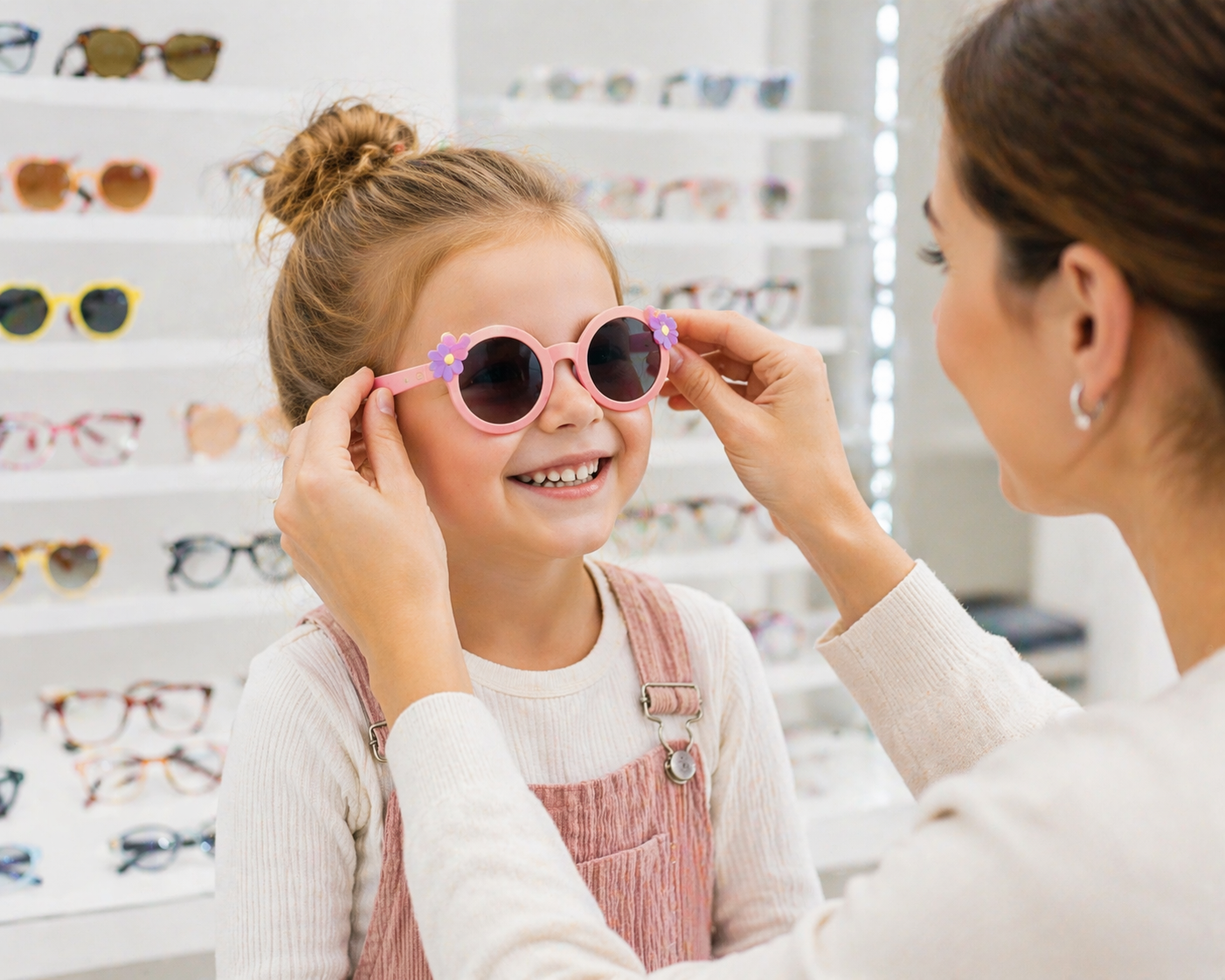
When buyers plan a kids eyewear assortment, color and style tend to get the most attention, but fit is what determines whether the product actually works on a child's face. Children are not small adults; their facial proportions, nose bridges, and head widths differ from adults and change noticeably from one age band to the next. A frame that photographs well but sits wrong will slide, pinch, or fall off, and that shows up later as returns and lost reorders.
This guide gives buyers a working understanding of kids eyewear sizing so you can plan an assortment across age groups and hold a clearer conversation with your supplier. The measurements here are planning references, not medical fitting advice, and the final fit for any individual child depends on that child's face and, for optical wear, professional adjustment.
1. The Three Measurements That Define Fit
Most eyewear sizing comes down to three numbers, usually expressed in millimeters. Lens width is the horizontal width of a single lens opening. Bridge width is the gap between the two lenses that sits over the nose. Temple length is the length of the arm that runs from the hinge to the tip behind the ear. These are often printed on the inside of an adult frame as three numbers, and the same logic applies to kids frames.
For children, the bridge is especially important because young noses are flatter and less defined, so a bridge designed for an adult profile will not sit correctly. Temple length and shape matter too, since kids frames often use curved or cable temples to stay put during active wear. Reading these three measurements together, rather than focusing on lens width alone, is the foundation of getting kids sizing right.
2. How Sizing Maps to Age Groups
There is no single global sizing chart that every factory follows, but kids eyewear generally clusters into a few age-based bands that buyers can plan around. The point is not to memorize exact millimeters, which vary by style and brand, but to understand that a full program usually needs more than one size to cover the age range you are targeting.
As a broad orientation, toddler and infant frames are the smallest, with narrow lens widths, short bridges, and often soft, flexible materials and straps to stay on active little ones. Preschool and early-childhood frames step up in size for children roughly in the early school years. School-age frames are larger again and start to approach small adult proportions for older children. Because these bands overlap and vary by market, buyers should treat them as planning tiers and confirm the actual dimensions of each style with the supplier rather than assuming an age label guarantees a fit.
3. Matching Sizing to Your Channel and Assortment
Sizing decisions should reflect how and where you sell. A pharmacy or optical channel serving prescription wearers has different needs than a fashion or gift channel selling sunglasses, and a marketplace assortment aimed at a broad age range needs wider size coverage than a focused boutique line. Deciding your target age band first tells you how many sizes your program needs and where to concentrate depth.
For many buyers, a practical approach is to anchor the assortment on the age band that drives the most volume, then decide whether to extend up or down with additional sizes. Carrying too many sizes fragments your buy and complicates replenishment, while too few sizes leaves gaps that customers notice. The right balance depends on your channel, and it is worth settling before you request samples so the sampling covers the sizes you actually plan to sell.
4. Materials, Flex, and Real-World Fit
Measurements describe a frame at rest, but kids wear eyewear in motion, so material behavior is part of fit. Flexible materials and spring or flexible hinges allow a frame to tolerate a wider range of face shapes and survive rough handling, which effectively broadens the fit window of a given size. Softer, wraparound, or strap-based designs are common for the youngest wearers because they stay in place during active play.
When you review sizing, ask the supplier how the material and hinge behave, not just what the dimensions are. Two frames with identical measurements can fit very differently if one is rigid and the other has flex. For sunglasses aimed at active outdoor use, this behavior is often as important to real-world fit as the printed numbers, and it is easy to overlook when comparing spec sheets alone.
5. Confirming Fit Through Samples
Because age labels and spec sheets only go so far, samples are where fit gets confirmed. When you receive samples, evaluate them against the sizing intent of your program rather than only checking that they look right in a photo. Practical checks during sample review include:
- Whether the frame dimensions match the specification you agreed for that size band
- Whether the bridge shape suits the age group's nose profile rather than an adult curve
- Whether temple length and shape keep the frame secure during movement
- Whether the material flex matches the durability your channel needs
- Whether sizes are visually and dimensionally distinct across the assortment tiers
If you have access to children in the target age range, real wear observation adds information no measurement can. Flagging a sizing mismatch at the sample stage is far cheaper than discovering it after a container arrives and returns start coming back, so treat sample review as the checkpoint where sizing is proven, not assumed.
6. Documenting Sizing for Reorders
Once a size is approved, record it so future orders stay consistent. Keeping the confirmed measurements, the approved sample reference, and any notes on material and fit behavior gives you a baseline to check reorders against. Kids programs often run season after season, and quiet drift in dimensions between production runs is a common source of fit complaints that are hard to trace without a documented standard.
A short sizing record per style — the three core measurements, the intended age band, and the approved sample details — turns fit from an informal understanding into a repeatable specification. That record is what lets you reorder with confidence and hold a supplier to the same fit you approved the first time.
Building a kids eyewear range across age groups?
If you are planning sizing across toddler, preschool, and school-age tiers, contact us to discuss size coverage, materials, and sample confirmation for your kids eyewear program before quotation.